Kindle
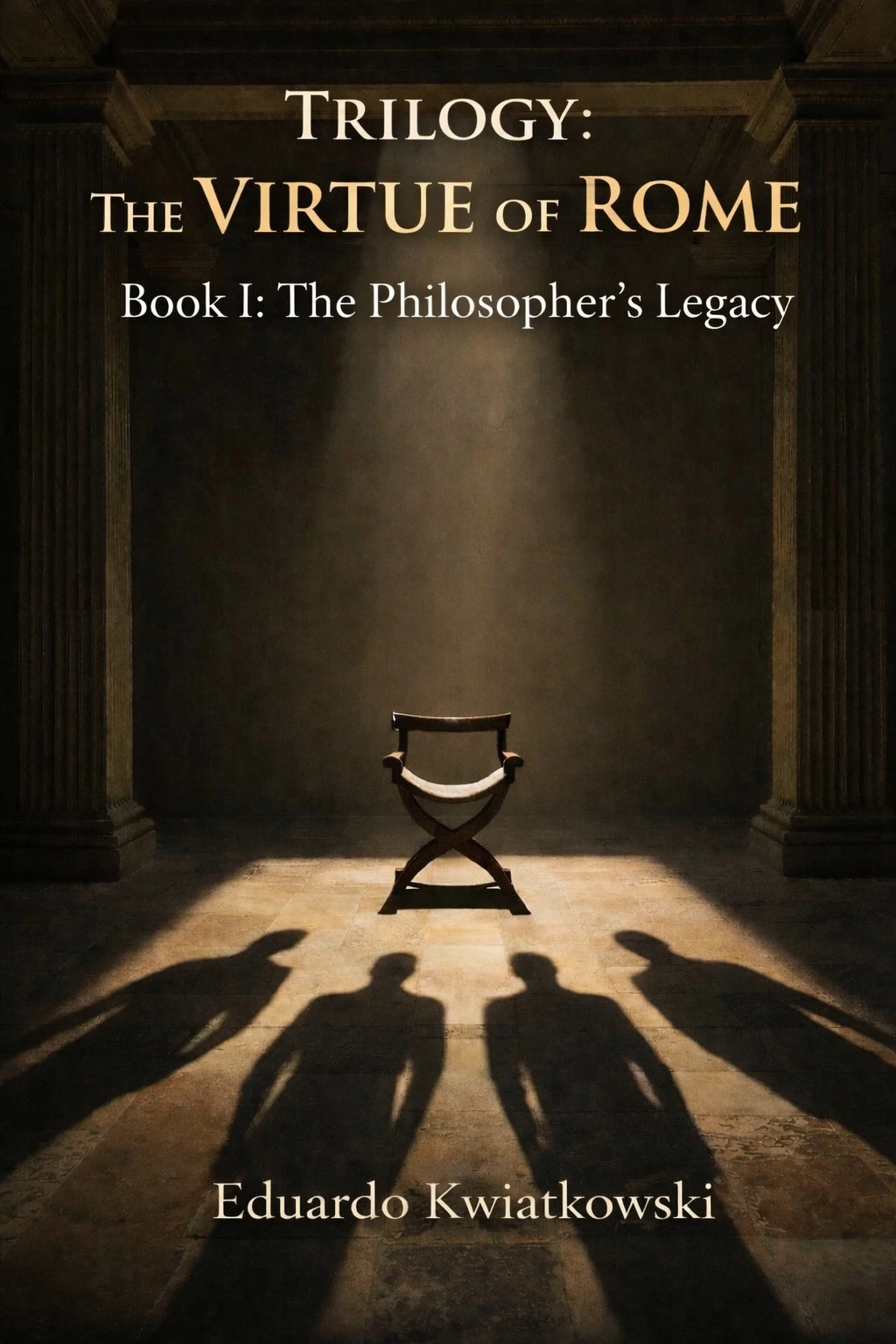
What if history’s greatest mistake never happened?
A.D. 175. The ice on the Danube breaks, and with it, the fate of Rome. In our timeline, Emperor Marcus Aurelius died leaving the Empire to his son Commodus—the cruel tyrant who accelerated Rome’s decline. In this story, Commodus dies first.
Marcus Aurelius, the last great philosopher, stands at the edge of the abyss: allow Rome to bleed in a civil war, or attempt the impossible. On his deathbed, he designs a desperate utopia: The Council of the Four Virtues. There will be no single Emperor. There will be four.
-
The Sword: Tiberius Pompeianus, the general who prefers honor to power.
-
The Purse: Avidius Cassius, the ambitious aristocrat who rules with gold.
-
Justice: Helvius Pertinax, the son of slaves who has not forgotten the sting of hunger.
-
The Mind: Claudius Severus, the jurist who believes the law can tame beasts.
Bound by an oath of blood and surrounded by mutual distrust, these four rivals must govern an Empire trying to devour them. The Emperor’s chair is empty, and the question is not who will sit in it… but who will be the first to betray the others to claim it.
"Game of Thrones" meets "I, Claudius" in this brutal and enthralling political alternate history about the Empire that might have been.
CHAPTER I THE BLACK HORSE
[The Emperor’s Note]: They say character is destiny. They are wrong. Sometimes destiny is simply a sheet of ice no one saw. In your world I forgave fortune for not taking my son. In this one, fortune did me the cruelest favor of all.
SCENE 1 — VINDOBONA
Danube frontier. March 17, A.D. 175.
The world was white, gray, and cold. On the frontier, no other colors existed.
Commodus spurred the black stallion and felt the frozen air burn his lungs. He liked that pain: it made him feel alive, different from the mummified old men huddled in his father’s tent, muttering about logistics and grain. He was a prince, and princes were not meant to smell of old parchment, but of horse sweat and winter.
“Your Highness!” The cry of a guard reached him, muffled by distance and wind. “The ground isn’t firm!”
Commodus laughed. He was fourteen, and immortality ran through his veins thicker than blood. He turned his head to see how much ground he had gained on his guards. They were slow. Heavy. He was Achilles in light armor.
“Faster!” he shouted at the animal, driving his heels into its flanks.
The Danube stretched to his right: a serpent of black water and drifting plates of ice colliding with the sound of breaking bones. The riverbank was coated in treacherous frost, that mixture of mud and snow that looks solid until it suddenly isn’t.
The horse—a magnificent Thracian beast, a gift from Pompeianus—obeyed. It was loyal, strong, and stupid. Exactly what Commodus demanded from his subordinates.
Its front left hoof searched for purchase on what looked like a flat stone covered in frozen moss. It was not. It was a sheet of ice stretched over a pit of muck.
The crack was sharp, like a gunshot.
Commodus’s world spun. The gray sky went below, the white earth above. There was no time for fear, not even for surprise. Physics respects no bloodline. The horse pitched forward with its full weight, and inertia hurled the boy like a slingstone.
Commodus flew. For one instant, he was truly free.
His head struck the granite outcrop marking the bend in the river. There was no pain: only a sudden white flash, and then a high, endless ringing that devoured the wind, the guards’ shouts, and the horse’s dying whinny as it thrashed in the mud with a broken leg.
Commodus lay on his back. A snowflake landed on his eyelash, but he did not blink.
Beneath his neck, on the untouched snow, a dark stain began to spread—slow, warm—drawing the map of a country that did not exist.
The guards arrived ten seconds too late. Ten seconds that changed the history of the next thousand years.
The centurion dropped to his knees, panting, and touched the boy’s neck. He looked at the others. Their faces were pale, not from the cold, but from the absolute terror of having to tell the most powerful man in the world that his heir had killed himself.
The black horse, dying, exhaled one last breath of steam.