Where to buy: https://a.co/d/09sLSMqS
In Uruk, 3200 BC, civilization is born from mud. But in a city of seals, precision can be a lethal sin.
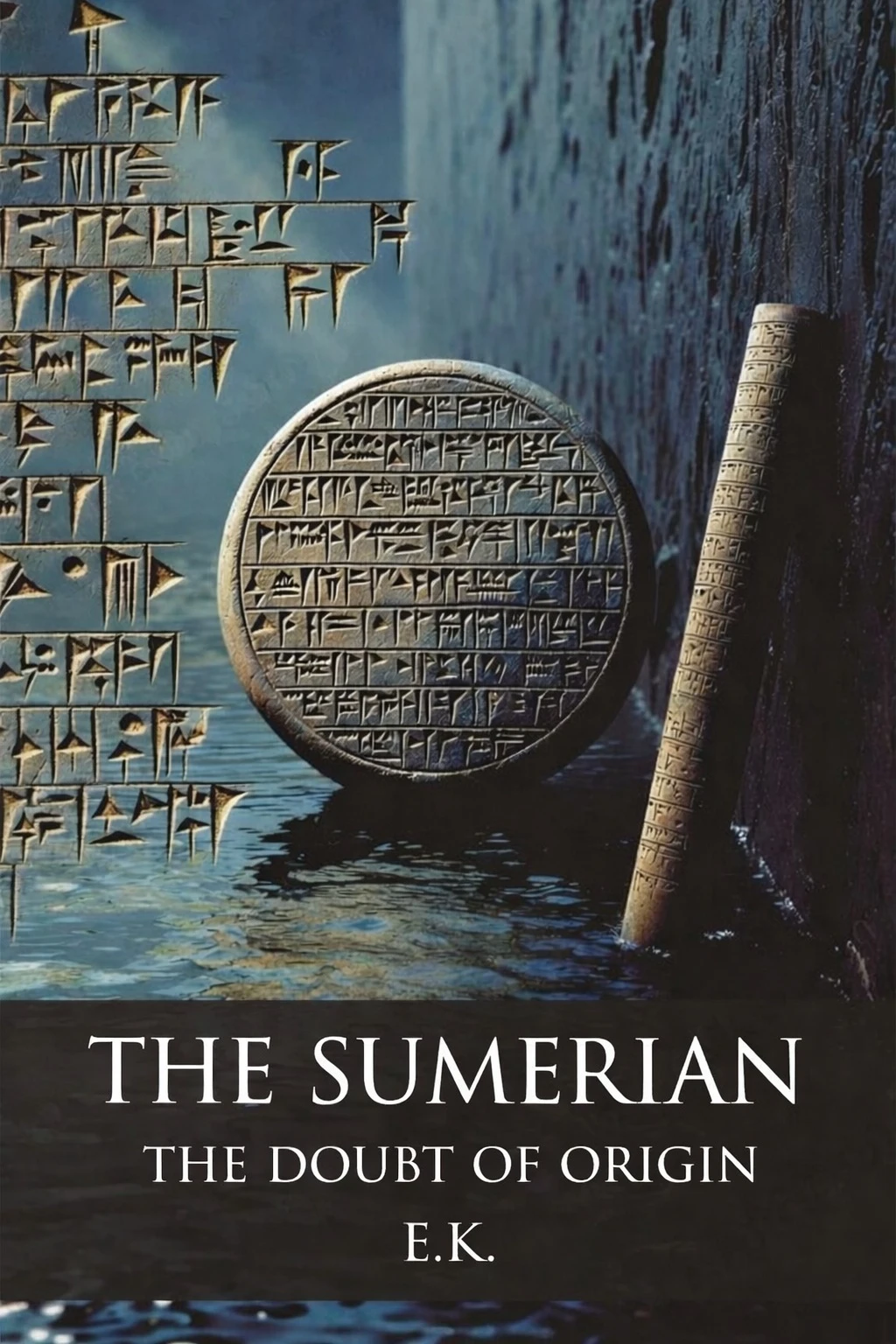
Aru is a scribe’s assistant obsessed with method. As the city learns to breathe with water and clay, he detects something impossible: "errors" in the distribution records that repeat with deliberate elegance. His investigation leads him to a discovery worse than a conspiracy: the Apsu, an archive buried beneath the canal, sealed with ancient bitumen and organized by "versions," as if a previous civilization had left behind manuals for building the world.
The findings are small but revolutionary: a clay bead with a quartz eye known as the igûm ("the one who calculates"), lenses capable of revealing micro-flaws in seals, and a phonetic script that turns the human voice into a weapon.
But progress has a price. On the other side stands Sipa-Kur, the Temple’s auditor, who understands that true dominion is not force, but the record. As the Temple responds with "purifications" and impeccable erasures, Aru finds himself trapped between a priesthood that fears knowledge and a city on the brink of combustion.+2
Aru must make a choice: bury the Apsu and die in silence, or scatter its secrets through a clandestine network of merchants and potters, igniting a future he can no longer control.+1
Knowledge will not be an altar. It will be a flow.
A gripping historical thriller about the origins of surveillance, the power of bureaucracy, and the first battle for the control of information.
Chapter Zero — Red Water
Etemen the child steps into warm mud.
It wasn’t earth: it was a living paste, wet, that sucked at your heels and gave you back a sticky cold. At that hour—before the sun had fully decided whether it would rise—the canal looked asleep. The water moved slowly, almost respectfully, as if it too were afraid of making noise.
A villager improves a sluice gate.
They’d seen him arrive the day before with hands black with bitumen and the tired pride of a smile. He brought no gold. No gods. He brought a new board, a straight slat, a wedge cut at an exact angle. “It’s only this,” he said, as if precision were humble thing. The men helped him set the piece; the women watched from a distance with that mix of hope and suspicion people save for things that promise too much.
The water changes owners.
When they released the wedge, the canal made a different sound. Not louder—different. As if the water, all at once, understood a path and surrendered to it. The flow turned with new obedience into the main trench. A minimal gesture, almost elegant. And yet, in that turn, something invisible changed hands.
One village laughs; another dries out.
Upstream, they saw the first effect and laughed—laughed with relief, disbelief, a joy too big to hold. The water filled the ditches with almost indecent greed, as if it had been waiting for that order all its life. Children splashed. Adults looked at each other as if they’d been saved without permission. But downstream, in the village that didn’t yet know, the furrows began to go still. The mud cracked first in silence, like old skin.
The scream arrives before dawn.
The scream wasn’t a word. It was an entire throat. It came running, men behind it—shadows twisted by haste. “They cut us off!” “They robbed us!” “They took the river!” No one explained calmly. No one could: future hunger hits like a fist in the chest. Etemen looked at his mother, searching for an answer. She didn’t return his gaze. No one wanted a child to see how wars begin.
But while the first fists were already rising, someone—a man with clean hands, no mud under his nails—stepped away from the canal’s edge and went to the board where the turns were recorded. He didn’t run to separate. He didn’t shout. He looked for a tablet. He looked for a name. He looked for the exact gap where a permission could be erased. Because even before there was blood, there was something worse: responsibility.
Stones fly; spears answer.
First came stones—thrown like insults, warnings, as if pain could fix a sluice gate. And while they flew, the man with clean hands scraped the fresh mud from a mark and smoothed it with his thumb, as if erasing a domestic mistake. Then someone lifted a spear, and there was no going back. Because a spear is not just a stick: it’s a declaration. Men shoved, spat, called each other thieves and cursed. The air filled with dust, with shouting, with that sour smell fear leaves that sour smell fear leaves when it runs hot.
The canal smells of iron and smoke.
Etemen saw one man fall, and the mud changed color. Blood mixed with water, and the canal seemed to accept the mixture without surprise. Someone set fire to a pile of dry reeds, and the smoke slid into throats—harsh, inevitable. The iron of heated points left a metallic odor in the air. It wasn’t epic. It was dirty. It was fast. It was human.
The river goes silent for a second: threat.
There was an instant—an exact second—when everything stopped. Not because people calmed down, but because the river, strangely, seemed to hold its breath. The water stopped its usual murmur. As if it listened. As if it chose. That silence wasn’t peace: it was a contained threat, the promise that if they continued, the river would charge its price—by flood or drought, by overflow or salt.
And in that silence, the erasure made no sound either. That was the worst part.
Etemen learns: order or fire.
They grabbed him by the arm and dragged him into a hut. From inside, peering through a crack, he watched the villager with the sluice gate try to explain—hands open—that he’d meant to help. No one listened. No one listens when water is missing. Etemen didn’t understand formulas or angles or wedges. He understood one simpler thing: an improvement can be a spark. And fire, once it catches, doesn’t ask permission.
That silence founds his dogma.
That night, when smoke had become part of the sky and the canal kept carrying red water, Etemen didn’t cry. He stayed still, eyes fixed, as if he’d learned a prayer without words. Years later, when he spoke of order, he wouldn’t speak of beauty or justice. He would speak of containment. Of levees not only for the river but for people. Of rituals as wedges. Of seals as sluice gates. And at the center of it all, like a hard heart: the weight of that second when the river fell silent.